Zinc-ion batteries get a boost from cross-campus research team
December 4, 2025
While burning electric vehicles, exploding e-bikes and melting smartphones no longer make the headlines, the issue of battery safety has yet to be fully resolved.
However, UBC researchers recently made a crucial breakthrough in battery research that may improve the longevity and safety of zinc-ion batteries.
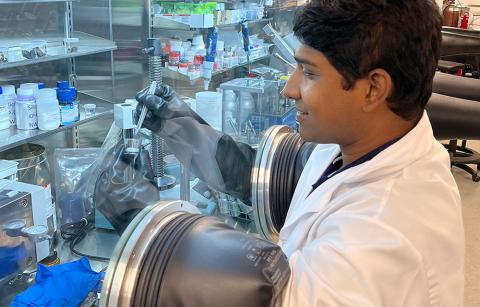
Led by doctoral student Musanna Galib, the team studied how dendrites can damage the protective coating on zinc-ion batteries, using labs at both UBC Okanagan and UBC Vancouver.
Dendrites, explains Galib, are harmful but minuscule, needle-like structures that grow on the surface of a battery’s electrode during charging. Over time, dendrites can pierce the separating layer between electrodes to cause a short circuit. This can lead to battery failure, damage or even an explosive fire.
“In zinc batteries, dendrites are a major obstacle to developing safe and rechargeable alternatives to lithium-ion technology as they limit the lifespan and reliability of the battery,” explains Galib.
Dr. Jian Liu, an associate professor with the School of Engineering and lead researcher with UBC’s Battery Innovation Research Excellence Cluster, says that while lithium-ion batteries dominate the market due to their high energy density and advanced manufacturing maturity, zinc batteries are cheaper to produce, safer and more environmentally friendly than lithium ones.
“Zinc batteries offer significant advantages as zinc is abundant and inexpensive, and the water-based electrolytes in zinc-ion batteries make them non-flammable,” he explains. “If we can solve the dendrite problem, zinc could become a strong alternative for grid storage and safe, affordable energy systems.”
The study, featured on the cover of ACS Applied Materials & Interfaces, showed that applying a thin film coating can initiate internal mechanical stresses that act as a shield and discourage dendrite growth. This mechanical barrier suppresses dendrite initiation and growth at the atomic scale, says Galib.
By using high-speed in situ optical microscopy, Galib and the team watched zinc dendrites grow in real time. They learned that the coated zinc surfaces stayed smoother and produced less hydrogen gas, even under high current densities.
“The computer simulations backed this up,” says Galib. “Residual stresses from the coatings made it harder for sharp dendrites to form, leading to more stable cycling and fewer safety risks.”
While the computational modelling and stress analysis simulations took place in the Modelling and Simulation Research Group’s lab, supervised by UBC Vancouver’s Dr. Mauricio Ponga, much of the experimental synthesis and electrochemical testing took place at UBC Okanagan’s Battery Innovation Centre.
Future energy storage systems need to be not only powerful but also safe and sustainable, adds Dr. Liu. He also notes this particular project is a strong example of the cross-campus research opportunities provided to UBC students.
“The collaboration between the two campuses was essential. It combined state-of-the-art simulations and experiments to uncover the coating’s stress-driven protection mechanism,” he adds. “This study provided the first clear connection between coating stress and electrochemical stability. Understanding and controlling these dendrites opens the door to safer, high-performance batteries for electric vehicles, wearable tech and renewable energy grids.”